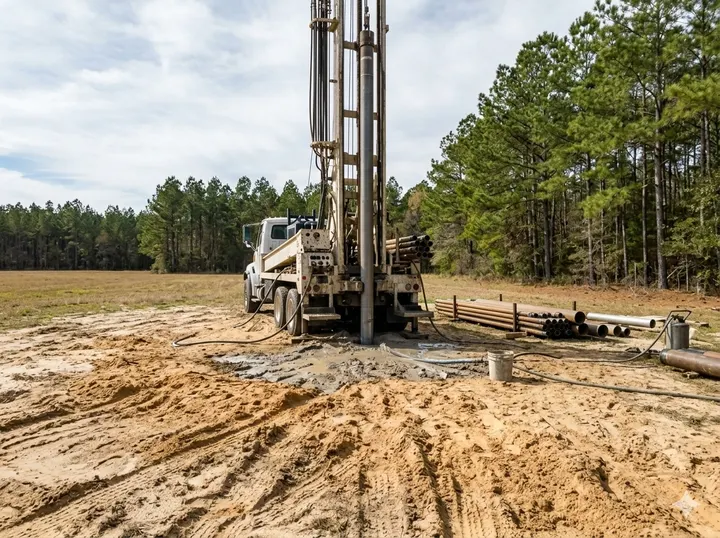
Water Well Drilling in
Gray & Jones County, GA
No municipal water connection on your property in Gray or Jones County? Gray Well Drilling provides complete water well drilling services — from the first site visit and Georgia EPD permit through deep well drilling, casing, pump installation, and a full system pressure test. One well drilling contractor, start to running water.
How much does well drilling cost in Gray, GA?
In Gray, Jones County, residential well drilling typically ranges from $5,000 to $12,000 or more, depending on well depth, the dense red clay and weathered bedrock formations encountered on your specific parcel, and the pump and pressure system selected. Properties in Haddock and Round Oak may encounter different aquifer conditions than those near Devereux, which affects total depth and drilling time. Gray Well Drilling provides a detailed written estimate before any work begins — submit your property location to get an accurate quote backed by on-site evaluation of your lot's specific drilling conditions.
What's Included in Water Well Drilling Service
Every new water well project covers the full scope of residential well drilling — from the state permit to the first glass of water out of your tap. Here is exactly what these well drilling services include.
Site Assessment
We evaluate your property to identify the best drilling location — factoring in setback requirements from septic systems and property lines, surface drainage, equipment access, and known local geology in Jones County. A good site assessment avoids complications during water well drilling and helps us give you an accurate estimate before any work begins.
Georgia EPD Permit Coordination
All new water well drilling in Georgia requires a Georgia EPD well permit from the Environmental Protection Division before any work begins. We prepare and file the permit application on your behalf, coordinate with EPD, and track the approval — which typically takes a few business days. You do not need to navigate state paperwork or interact with EPD directly for your Jones County well drilling project.
Deep Well Drilling — Typically 80 to 200 Feet
The drill rig advances through middle Georgia's dense red clay layers and into the productive water-bearing zones of the Floridan aquifer system. Most residential well drilling projects in Jones County reach total depth somewhere between 80 and 200 feet. Drilling continues until reaching a reliable, high-quality water zone — depth is determined by what the geology presents, not by a preset target.
Steel Casing with Grout Seal
A steel well casing is installed inside the borehole during water well drilling to prevent the walls from collapsing and to isolate the well from surface water, shallow groundwater, and contaminants. The annular space between the casing and the borehole wall is filled with a grout seal — required by Georgia EPD for every new well installation in Jones County — that prevents surface water from migrating down the outside of the casing and into your water supply.
Submersible Pump Installation
A submersible pump is lowered into the wellbore to the appropriate depth and connected to a waterproof drop cable as part of well drilling and pump installation. The pump is sized based on the well's production capacity and your household's water demand. Submersible pumps are the standard for residential well drilling in Jones County because they are efficient, quiet at the surface, and reliable under the sustained demand of a household water system.
Pressure Tank & Pressure Switch
The pressure tank is installed at the wellhead as part of every new well installation and serves as a buffer that maintains consistent water pressure throughout your home without cycling the pump every time a faucet is opened. It works in combination with a pressure switch, which signals the pump to run when pressure drops below the set threshold — a standard component of residential well drilling and pump service in Gray, GA. This protects the pump motor from short-cycling damage and extends pump life significantly.
System Pressure Test & Flow Test
Before we leave the property after any Jones County well drilling project, we run a full pressure and flow test to verify the pump is delivering water at the correct pressure and flow rate. The pressure tank is pre-charged and verified, the pressure switch cut-in and cut-off settings are confirmed, and the wellhead is sealed. We do not consider a well drilling and pump service job complete until the system is running correctly and the homeowner has confirmed water throughout the house.
Well Completion Record
After each water well drilling project, we file a well completion report with Georgia EPD documenting the well's depth, casing specifications, grout seal details, and static water level. A copy is provided to the property owner. This record is an important document for your files — it may be needed for future well drilling and pump service calls, property transactions, or water testing interpretation.
Our Water Well Drilling Process in Gray, GA
From your first inquiry to the moment water flows from your tap, here is how the well drilling process moves from start to finish with Gray Well Drilling.
Site Assessment & Quote
We review your property, note any setback requirements from septic systems and property lines, evaluate access for the drill rig, and discuss your household water needs. You receive a written water well drilling estimate that covers drilling, casing, pump, pressure system, and permit coordination — no hidden line items added later.
Georgia EPD Permit Filing
We prepare and submit your Georgia EPD well permit application to the Environmental Protection Division before any well drilling begins. In most cases, EPD processes new well drilling permits within a few business days. We track the application and notify you when the permit is approved and a drill date can be scheduled. No drilling happens before the permit is in hand — Georgia law requires it, and we follow it.
Drilling Day — Typically Day 1 of 1 or 2
The drill rig arrives at the permitted location to begin water well drilling. We advance through the red clay overburden, then through saprolite, and into the fractured bedrock of the Floridan aquifer system. The well drilling process continues until a productive, high-quality water-bearing fracture zone is reached — typically between 80 and 200 feet in Jones County. Drill cuttings are logged and the borehole is tracked as we go.
Casing, Grout Seal & Wellhead
Steel casing is set inside the borehole and the annular space is grouted to EPD specification — a required step in every Jones County well drilling project. The wellhead is installed above grade with a sanitary well seal. This step is what separates a properly constructed well drilling result from a problem well — the grout seal prevents surface contamination from migrating downward, and the sanitary seal keeps insects, rodents, and debris out of the casing permanently.
Pump & Pressure System Installation
The submersible pump is assembled, lowered to the correct depth on the drop pipe, and the waterproof power cable is secured as part of well drilling and pump installation. The pump is connected to the household water line. The pressure tank and pressure switch are installed and calibrated for your new well installation. The electrical circuit from the breaker panel to the pump control box is verified for correct voltage and overload protection.
Flow Test, Water Test & Running Water
The system is started and the pump is run through a flow and pressure test as the final step of the well drilling process. We verify that the pump delivers the expected flow rate, that the pressure tank cycles correctly between the cut-in and cut-off pressures, and that there are no leaks at any connection. A basic field water check is performed and we recommend scheduling a certified lab water test within the first 30 days — standard practice after new well drilling in Gray, GA. Once everything checks out, you have running water.
Water Well Drilling in Gray — Common Questions
Questions specific to new water well drilling and installation in Jones County, Georgia. For general well questions, visit our main FAQ page.
How deep are wells drilled in Jones County, GA?
Most residential well drilling in Jones County reaches between 80 and 200 feet to tap the Floridan aquifer system. The exact depth depends on the local geology under your specific property — the thickness of the red clay overburden, how deep the saprolite layer extends, and where productive water-bearing fractures in the crystalline bedrock are encountered. Some areas of Jones County consistently yield water well drilling results in the 80 to 120-foot range; others routinely require 160 to 200 feet of deep well drilling before a reliable fracture zone is found. Depth is determined by what the ground presents, not by a preset target.
Do I need a Georgia EPD permit to drill a new well?
Yes — Georgia law requires a permit from the Environmental Protection Division before any new water well can be drilled anywhere in the state, including Jones County. The EPD permitting requirement exists to protect groundwater quality and ensure wells are properly sited relative to septic systems and neighboring properties. The permit documents are filed before drilling begins and a completion report is submitted afterward. Gray Well Drilling handles the entire permit process as part of every new water well drilling project — the property owner does not need to contact EPD or navigate the application independently.
How long does the new well installation process take from start to finish?
The well drilling itself typically takes one to two days on your property once the crew arrives. Before water well drilling can begin, the Georgia EPD well permit must be approved — in most cases this takes a few business days from submission. After the well drilling process is complete, pump and pressure system installation is usually finished the same day or the following morning. From the time you submit your quote request to the moment you have running water, plan for approximately one to two weeks — the bulk of that time is permit processing and scheduling. If your situation is urgent, let us know in your quote request and we will do our best to expedite your Jones County project.
What happens after a well is drilled?
Once water well drilling reaches a productive water-bearing zone in the Floridan aquifer system, the bore is lined with steel casing and a grout seal is applied around the top section to prevent surface water from entering the well. A submersible pump is then lowered into the casing to the appropriate depth below the static water level, connected to a pressure tank and pressure switch installed at the wellhead, and the system is tested for flow rate and pressure. A well completion record is filed with Georgia EPD documenting the well drilling depth, casing specifications, and geology encountered. In most cases in Jones County, the pump is running and delivering water to the house within the same day the new well installation is finished.
Why is well drilling so expensive?
The well drilling cost for a new residential well in Jones County — typically $5,000 to $12,000 installed — reflects the full scope of equipment, materials, and skilled labor required. A rotary drilling rig weighs tens of thousands of pounds, consumes significant fuel per foot drilled, and requires a licensed well drilling contractor to operate. Steel casing and grout materials alone can run several hundred dollars per new well installation. The Georgia EPD well permit, submersible pump, drop pipe, pressure tank, and pressure switch are all required components of a complete installation — none of them are optional. When spread across the 20 to 40-year service life of a well, the cost per year is typically far lower than municipal water bills over the same period.
What type of pump is installed with a new well in Jones County?
Residential well drilling in Jones County results in a well equipped with a submersible pump — a sealed motor and pump assembly that is installed inside the well casing at depth, below the static water level. Submersible pumps are the standard for Jones County well drilling because they push water to the surface more efficiently than surface-mounted jet pumps, they operate quietly (all sound is underground), and they are well-suited to the depths typically required to reach productive water in middle Georgia. The pump is paired with an above-ground pressure tank and pressure switch that maintain steady household water pressure and protect the pump motor from short-cycling. Pump horsepower and capacity are selected to match both the well's production rate and your household's water demand.
Request a Free New Well Drilling Quote
Tell us about your property and water needs. We will follow up promptly with next steps.
Get a Free Quote for New Well Drilling
Serving Gray, Haddock, Round Oak, Cleveland, Devereux, and all of Jones County, GA for residential water well drilling. Use the quick quote form on our homepage and we'll follow up promptly with next steps.
Free estimate. No obligation. Response within 24 hours.